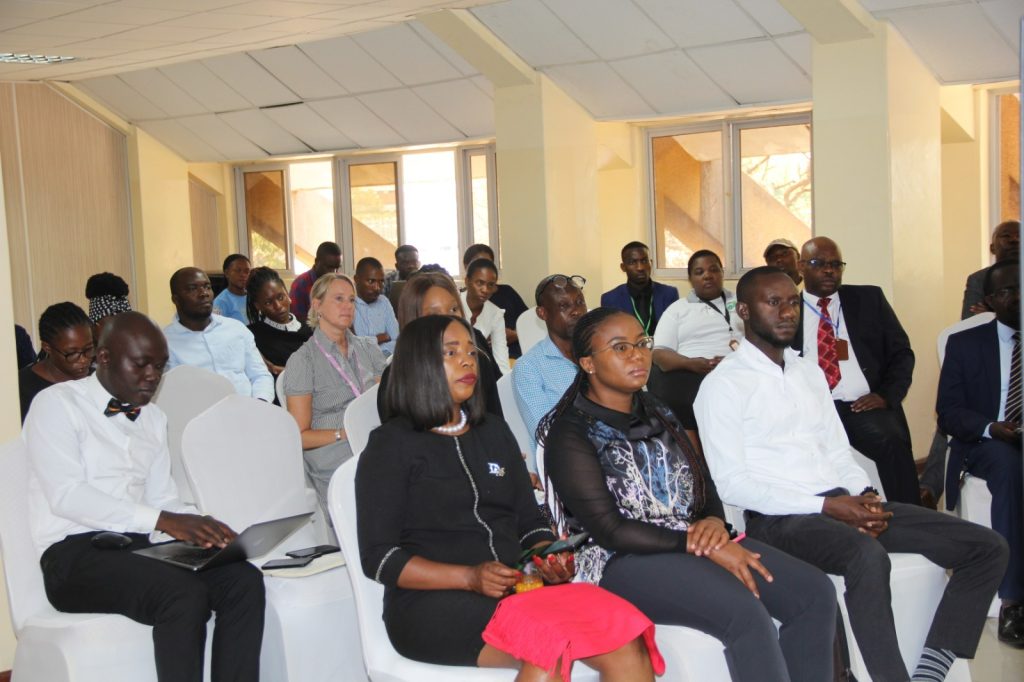
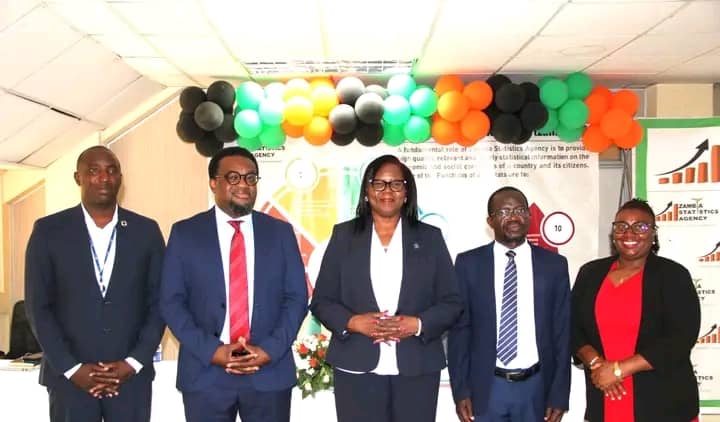
The Zambia Statistics Agency (ZamStats), launched its first-ever Integrated Agricultural Survey (IAS) Report that was conducted in 2024. The Agency conducts two primary agricultural surveys: the Crop Forecast Survey (CFS), implemented in the first quarter of the year and the Post-Harvest Survey (PHS) conducted in the last quarter of the year.
The CFS provides early estimates of crop production during the growing season while the PHS validates CFS data by collecting actual production figures after harvest. These activities are vital for strategic planning, resource allocation, and the development of intervention programmes in the agricultural sector, contributing to overall national development.
Present at the launch of the Integrated Agricultural Survey (IAS) were several distinguished guests, including Mr. Succeed Mubanga, Director of Policy, Planning and Information representing the Permanent Secretary in the Ministry of Fisheries and Livestock; Mr. Paul Mumba, Director of Planning and Research representing the Permanent Secretary in the Ministry of Labour and Social Security. Also in attendance was Mr Mwiinga Malambo representing the International Labour Organization (ILO) Country Office Director for Zambia and Malawi, Mr. Wellington Chibebe.
The Acting Statistician General (ASG) Mrs. Sheila S. Mudenda revealed that a total number of 2,143,475 households were covered by the Type of Agricultural Activity segmented into categories of Crop production (2,123,130), Livestock production (1,355,643) and Honey Production (60,429).
The results show that data was collected on household heads by Agricultural training. Of these, 75.7 percent of household heads reported that they had not received any form of agricultural training, 18.0 percent received informal training, 5.3 percent had vocational training and only 1.0 percent had received formal agricultural education.
Data on maize production shows that Northern Province recorded the highest with 287,576 metric tonnes, followed by Eastern province with 221,446 metric tonnes while Lusaka Province had the lowest with 15,315 metric tonnes.
Analysis by livestock raising shows that Southern Province recorded the highest number of cattle raised, totaling 1,747,550, followed by Central Province with 720,758. The findings on cattle mortality due to diseases among small and medium-scale farmers showed that Copperbelt Province recorded the highest mortality rate at 11.8 percent, followed by Western Province at 10.5 percent.
Regarding the number of chickens raised by type and province in both households and establishments, the results show that there were a total number of 9,659,902 village chickens; 5,518,108 broiler chickens, and 2,210,273-layer chickens raised countrywide. Central Province recorded the highest number of village chickens raised at 1,916,131, followed by Southern Province with 1,600,863.
For broiler chickens, Lusaka Province had the highest number at 1,416,391, followed by Central Province with 428,198. Similarly, Lusaka Province recorded the highest number of layer chickens at 100,662, while Luapula had the lowest with 175-layer chickens raised.
On milk production, the IAS results shows that a total of 151.4 million litters of milk was produced in 2024 countrywide, with Southern province producing the highest (62.1 million litres), followed by Central province (34.8 million litres) .
In conclusion, Acting Statistician-General Mrs. Sheila S. Mudenda stated that the survey had been both comprehensive and robust, requiring more time for planning and implementation. She noted that extensive consultations with key stakeholders on the methodology, modalities, and overall implementation had also taken additional time, but were essential to ensure accuracy, inclusiveness, and credibility.
As the first-ever Integrated Agricultural Survey, she emphasized that the data processing and validation stages were lengthy but necessary to maintain the quality, reliability, and integrity of the results.
The Acting Statistician General further thanked and called upon all stakeholders; Government ministries, local authorities, academia, civil society, and our cooperating partners, to continue supporting the work of ZamStats and to use these products to inform planning, monitor progress, and improve the lives of all Zambians.