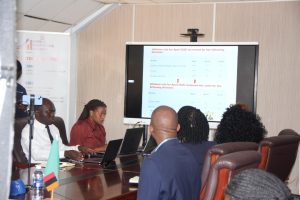
The Zambia Statistics Agency (ZamStats) has released the key statistical highlights for the Month of April 2026. The Statistician – General (SG), Mrs. Sheila Mudenda, has announced that the annual inflation continued to ease in April 2026, declining to 6.8 percent from 7.1 percent recorded in March 2026. This indicates that, on average, prices of goods and services rose by 6.8 percent between April 2025 and April 2026.
She further noted that annual food inflation slowed down to 7.3 percent from 7.8 percent in March 2026, largely due to price movements of food items such as cereals ((Breakfast Mealie meal, Roller mealie meal, Maize grain, Rice imported, Wheat Plain Household Flour) oils and fats, vegetables, and eggs.
In contrast, non-food inflation edged up to 6.0 percent in April 2026 from 5.9 percent in March 2026, driven by price movements in non-food items including pharmaceutical products, domestic and regional airfares, and accommodation services.
The Statistician General also reported that the overall monthly inflation rate for April 2026 went up to 0.7 percent in April 2026 from 0.6 percent in the previous month.
Speaking during the Dissemination, the SG also highlighted provincial inflation rates, noting that Lusaka Province recorded the highest annual inflation rate at 8.6 percent while Luapula Province recorded the lowest at 4.0 percent. She added that the annual inflation rates for Eastern and Southern Provinces remained unchanged at 6.0 percent and 6.6 percent, respectively.
Mrs. Mudenda further disclosed that March 2026 recorded a trade surplus of K0.8 billion, compared to a surplus of K5.7 billion in February 2026. Total trade increased by 0.9 percent to K49.2 billion from K48.8 billion in February 2026. Imports rose by 12.3 percent, from K21.5 billion in February 2026 to K24.2 billion in March 2026, while exports declined by 8.1 percent from K27.2 billion to K25.0 billion over the same period.
She also reported that Zambia’s population is projected to reach 39.9 million in 2047, representing a demographic shift characterized by decelerating annual growth rates, increased urbanization, and rising life expectancy. These trends underscore the critical need for evidence-based planning and resource allocation to effectively address the socio-economic demands of a growing and urbanizing society.