Overview
The 2025 Economic Establishment Census (EEC) was a nationwide exercise undertaken to map, count, and characterize all active economic establishments across Zambia’s 1,858 wards, providing the most comprehensive snapshot of the country’s economic landscape to date. Overall, the census captured a total of 485,034 establishments operating across all provinces of Zambia.
The 2025 EEC provided a detailed overview of the distribution of business establishments operating within Zambia, capturing the full spectrum of economic activity across industries, provinces, and size categories. One of the main objectives of the census was to develop a comprehensive Statistical Business Register (SBR). The register will serve as a sampling frame for future economic and business surveys, as well as support the compilation of national accounts and other macroeconomic statistics.
This article discusses the characteristics of establishments captured during the census, with particular focus on regular businesses and micro businesses. Regular businesses refer to establishments operating from permanent structures such as buildings, offices, shops, and containers, while micro businesses include small-scale establishments operating from market stalls, kiosks, and other temporary or informal structures. The article further examines the distribution of workers engaged in these establishments, providing insights into the structure of employment and business operations across industries and provinces.
Regular economic establishments
The EEC 2025 identified and registered the characteristics of 358,400 regular economic establishments. The main characteristics that were registered are the location of the establishment, the main activity, the nature of the establishment and details about ownership and employment.
Establishments by Industry
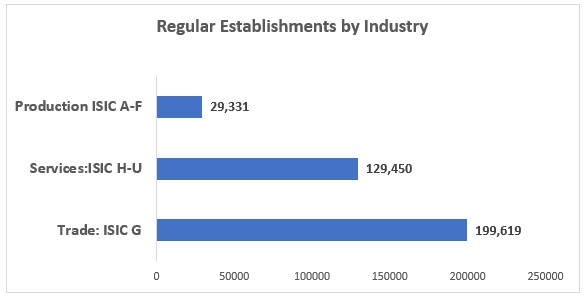
Trade activities account for the majority of regular establishments in Zambia. Of the 358,400 regular establishments identified during the census, 199,619 establishments (55.7 percent) were engaged in trade and motor vehicle repair activities. Service activities accounted for 129,450 establishments (36.1 percent), while production activities accounted for 29,331 establishments (8.2 percent).
At a more detailed industry level, trade and motor vehicle repair activities remains dominant, followed by other service activities indicating 46,923 while accommodation and food activities accounted for 39,414 establishments, while manufacturing activities accounted for 26,768 establishments. Banking & insurance accounted for 25,612 while education accounted for 4,191. The industries with the least recorded number of regular establishments were Electricity, gas, steam and air conditioning supply activities contributing only a very small share of not more than 46 of the total number of regular establishments.
Establishments by Province
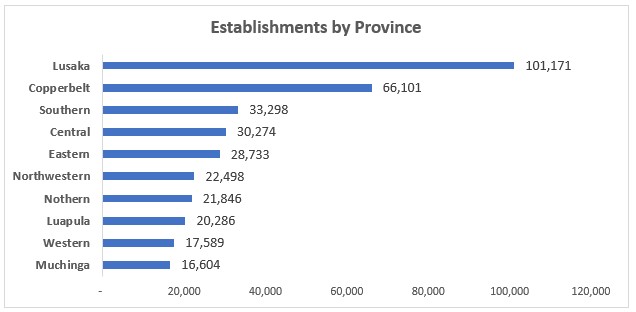
The regular economic establishments are not equally spread over Zambia. Lusaka Province recorded the largest number of regular establishments with 101,171 establishments (28.2 percent), accounting for approximately one-third of the national total. Copperbelt Province followed with 66,101 establishments (18.4 percent), while Southern Province accounted for 33,298 establishments (9.3 percent).
Muchinga Province recorded the fewest number of regular establishments with 16,604 establishments (4.6 percent). Western Province accounted for 17,589 establishments (4.9 percent), while Luapula Province recorded 20,286 establishments (5.7 percent). The concentration of regular establishments in Lusaka and Copperbelt reflects the higher levels of commercial and trading activities in these provinces.
Turnover Size Class
Most regular establishments operate at very low levels of turnover. The majority of establishments, 223,606, reported annual turnover of K250,000 or less. A further 15,739 establishments reported annual turnover ranging between K250,001 and K1,000,000, while 4,862 establishments recorded turnover between K1,000,001 and K10,000,000. In addition, 1,944 establishments reported annual turnover ranging from K10,000,001 to K50,000,000. Only a small proportion of establishments recorded annual turnover exceeding K50 million.
A considerable number of establishments, however, either did not state or did not know their turnover levels. This category accounted for 108,985 establishments, reflecting the challenges associated with collecting financial information from highly informal and small-scale businesses. The large proportion of establishments with unspecified turnover may also indicate limited record-keeping practices among some enterprises.
Ownership Characteristics
Most regular establishments in Zambia are owned by a single individual. The census identified 269,569 establishments with one owner, accounting for 75.2 percent of all regular establishments. Establishments with two owners accounted for 14,709 establishments, while only 5,773 establishments reported three or more owners.
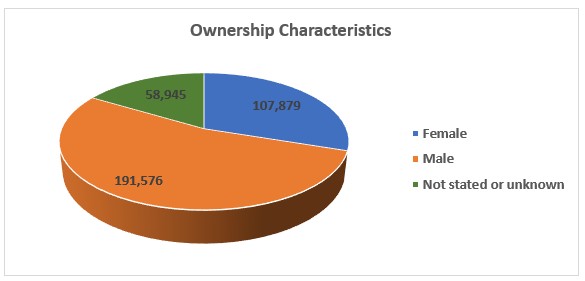
In terms of gender, male-owned regular establishments dominated the sector. Male principal owners or directors accounted for 191,576 establishments (53.5 percent), while female-owned establishments accounted for 107,879 establishments (30.1 percent). A small proportion of establishments did not state the gender of the principal owner or director.
The majority of regular establishments were also Zambian-owned. Out of all micro establishments, 276,450 establishments reported Zambian ownership, while only a small number reported foreign ownership from countries such as Tanzania, Burundi and the Democratic Republic of Congo.
Regular Establishment Table.xlsx
Micro establishments
The EEC 2025 identified and registered 126,634 informal micro establishments across Zambia. Information collected included the location of the establishment, economic activity, ownership characteristics, turnover size class and employment size class.
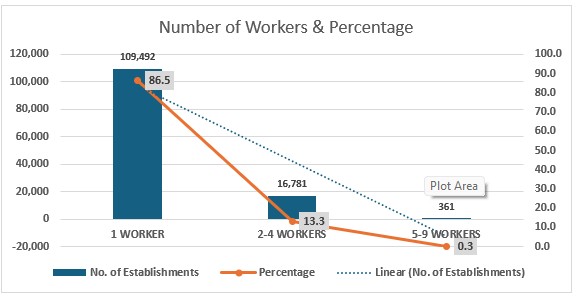
Most micro establishments are very small in terms of employment. The majority of establishments (86.5 percent) reported only one worker, while 13.3 percent reported between 2 and 4 workers. Only a very small proportion of 0.3 percent of establishments reported five or more workers confirming the highly informal and small-scale nature of micro establishments in Zambia.
Establishments by Industry
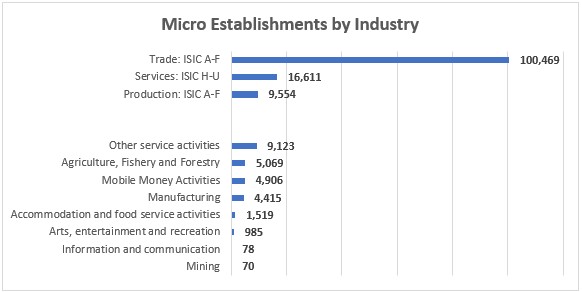
Trade activities account for the overwhelming majority of micro establishments in Zambia. Of the 126,634 micro establishments identified during the census, 100,469 establishments (79.3 percent) were engaged in trade and motor vehicle repair activities. Service activities accounted for 16,611 establishments (13.1 percent), while production activities accounted for 9,554 establishments (7.5 percent).
At a more detailed industry level, trade and motor vehicle repair activities remains dominant, followed by agriculture, forestry and fishing activities indicating 5,069 while manufacturing activities accounted for 4,415 establishments, while accommodation and food service activities accounted for 1,519 establishments. Mobile money activities accounted for 4,906 while arts, entertainment and recreation (985) and other service activities accounting for 9,123. The industries with the least recorded number of micro- establishments were the mining industry with 70 and information and communication activities contributing only a very small share of not more than 78 of the total number of micro establishments.
Establishments by Province
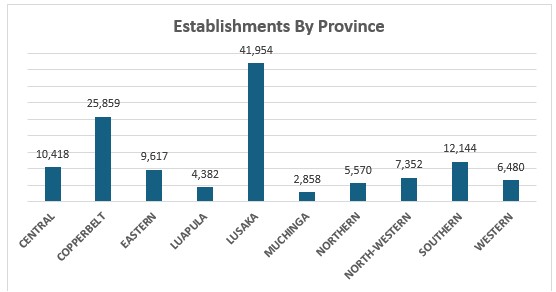
Micro establishments are not evenly distributed across Zambia. Lusaka Province recorded the largest number of micro establishments with 41,954 establishments, accounting for approximately one-third of the national total. Copperbelt Province followed with 25,859 establishments, while Southern Province accounted for 12,144 establishments.
Muchinga Province recorded the fewest number of micro establishments with 2,858 establishments. Luapula Province accounted for 4,382 establishments, while Northern Province recorded 5,570 establishments. The concentration of micro establishments in Lusaka and Copperbelt reflects the higher levels of commercial and trading activities in these provinces.
Establishments by Start Year
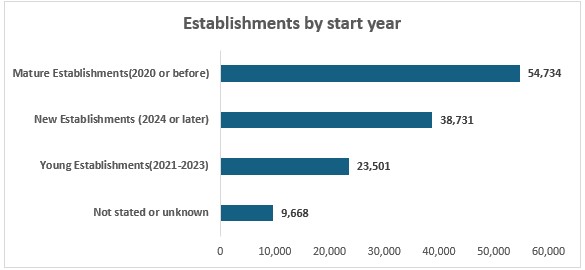
A significant proportion of micro establishments are relatively new businesses. Establishments created in 2024 or later accounted for 38,731 establishments, representing 30.6 percent of the total. Young establishments created between 2021 and 2023 accounted for 23,501 establishments (18.6 percent).
Mature establishments established in 2020 or earlier accounted for 54,734 establishments, representing 43.2 percent of the total number of micro establishments. Meanwhile, 9,668 establishments did not state or did not know their year of establishment.
Ownership Characteristics
Most micro establishments in Zambia are owned by a single individual. The census identified 118,589 establishments with one owner, accounting for 93.7 percent of all micro establishments. Establishments with two owners accounted for 2,073 establishments, while only 483 establishments reported three or more owners.
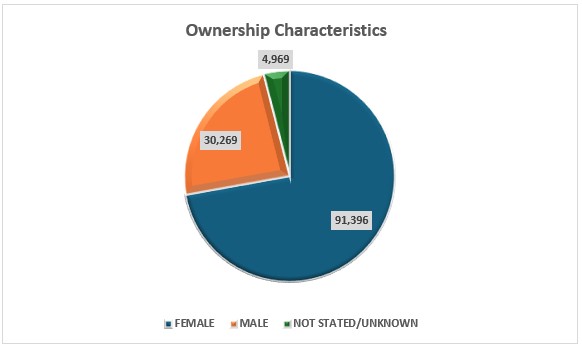
In terms of gender, female-owned micro establishments dominated the sector. Female principal owners or directors accounted for 91,396 establishments (72.2 percent), while male-owned establishments accounted for 30,269 establishments (23.9 percent). A small proportion of establishments did not state the gender of the principal owner or director.
The majority of micro establishments were also Zambian-owned. Out of all micro establishments, 120,189 establishments reported Zambian ownership, while only a small number reported foreign ownership from countries such as Tanzania, Burundi and the Democratic Republic of Congo.
Turnover Size Class
Most micro establishments operate at very low levels of turnover. The majority of establishments (97,608) reported annual turnover of K250,000 or less. Only a very small number of establishments reported turnover exceeding K10 million.
A considerable proportion of establishments, however, did not state or did not know their turnover levels. This category accounted for 27,045 establishments, highlighting the challenges of collecting financial information from highly informal businesses.
Looking Ahead
In the coming months, Zamstats will continue publishing additional findings from the Economic Establishment Census 2025, highlighting different aspects of the business sector in Zambia.
The results from the EEC will also support the development of a modern Statistical Business Register (SBR), which will serve as the foundation for future business statistics, annual economic surveys and GDP rebasing exercises. The experience gained through the census, including digital data collection and automated processing techniques, will further contribute to the modernization of statistical production within ZamStats.
Informal Micro Establishment table.xlsx
Workers Publication
The EEC 2025 identified and registered total of 485,034 establishments across Zambia, employing 1,094,751 workers during the reference period.
The distribution of workers by broad industry classification shows that Trade activities accounted for the largest share of establishments, with 300,088 establishments, representing 61.9 percent of all establishments. The sector employed 454,509 workers, accounting for 41.5 percent of the total workforce captured during the 2025 Economic Establishment Census. The Services sector recorded 146,061 establishments, representing 30.1 percent of all establishments, and employed 416,513 workers, accounting for 38.0 percent of total workers. Meanwhile, the Production sector accounted for 38,885 establishments, representing 8.0 percent of all establishments, and employed 223,729 workers, equivalent to 20.4 percent of the total workforce captured during the census.
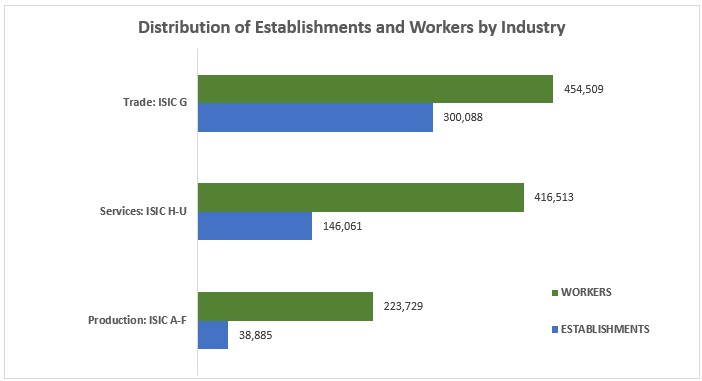
Establishments and Workers by Industry
At the industry level, the Wholesale and Retail Trade sector dominated the economy, accounting for 300,088 establishments, representing 61.9 percent of all establishments. The sector also employed 454,509 workers, accounting for 41.5 percent of total employment. This highlights the significant role of trade in economic activity and job creation. The Manufacturing industry recorded 31,183 establishments (6.4 percent) and employed 140,345 workers (12.8 percent of total employment). This suggests that manufacturing establishments tend to employ more workers per establishment compared to trade enterprises. The Accommodation and Food Service Activities sector accounted for 40,933 establishments (8.4 percent) and employed 120,169 workers, representing 11.0 percent of total employment. This reflects the importance of tourism-related and hospitality activities in employment generation. The Other Service Activities sector registered 56,046 establishments (11.6 percent) and employed 106,370 workers (9.7 percent of total employment), making it one of the largest sectors in terms of the number of businesses.
Although the Mining and Quarrying sector accounted for only 307 establishments (0.1 percent), it employed 33,199 workers, representing 3.0 percent of total employment. This indicates a relatively high labour intensity per establishment compared to many other industries. A similar pattern is observed in sectors such as education, health, and administrative and support service activities.
Employment-size class
The distribution of workers by size class of employment shows that employment in Zambia is largely concentrated in small and medium-sized establishments. A total of 1,094,751 workers were employed across all establishments during the reference period. Establishments employing one worker accounted for the largest share of employment, engaging 315,885 workers (28.9 percent). This was closely followed by establishments employing 2 to 4 workers, which accounted for 306,439 workers (28.0 percent). Together, these establishments with fewer than five workers employed 622,324 workers (56.8 percent). Establishments employing 5 to 9 workers accounted for 98,376 workers (9.0 percent), while those employing 10 to 19 workers employed 71,140 workers (6.5 percent). Establishments in the 20 to 49 workers category employed 73,666 workers, representing 6.7 percent of total employment. Employment in larger establishments was comparatively lower in terms of numbers of establishments but remained significant in terms of workers engaged. Establishments employing 50 to 99 workers accounted for 52,276 workers (4.8 percent), while those with 100 to 199 workers employed 62,486 workers (5.7 percent).
The largest employment contribution among large establishments came from enterprises employing 200 or more workers, which accounted for 114,483 workers (10.5 percent). This indicates that although large establishments are relatively few in number, they play an important role in generating employment. The employment structure demonstrates the critical role of MSMEs in job creation and economic activity.
Establishments and Workers by Province
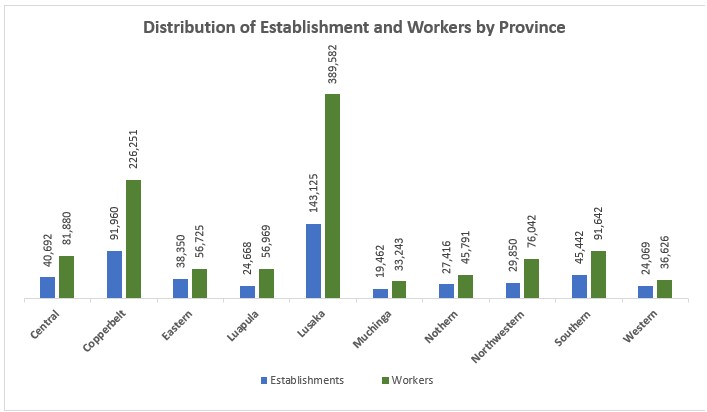
The distribution of establishments and employment is not evenly distributed across Zambia. It is highly concentrated in a few provinces. Lusaka Province recorded the highest number of establishments (143,125) and workers (389,582) accounting for 29.5 percent of all establishments and 35.6 percent of all workers. Copperbelt Province ranked second with 91,960 establishments (19 percent); and 226,251 workers (20.7 percent). Other provinces recorded substantially lower shares of establishments and employment. Muchinga Province recorded the lowest number of establishments with 19,462 establishments (4 percent) and 33,243 workers (3.04 percent). Western Province accounted for 24,069 establishments (5 percent) and 36,626 workers (3.3 percent), while Luapula Province recorded 24,668 establishments (5.1 percent) and 56,969 workers (5.2 percent). The concentration establishments and workers in Lusaka and Copperbelt reflects the higher levels of commercial and trading activities in these provinces.